Sunday by Sunday: Year C weekly devotions

SxS YCPostThe Christian Calendar begins each year on the First Sunday in Advent which in 2024 takes place on December 1st. We will be heading into Year C which will complete the three-year cycle of Bible readings. I’ve written a book of devotions for this calendar year and called it ‘Sunday by Sunday – Year C.’

The purpose of this book is to present a weekly meditation based on the Gospel texts for the Year C. Each meditation includes a highlighted verse from the Gospel text, as well as a point to ponder supplemented with a short prayer. It can be used as a time of preparation before Sunday worship or as a personal devotion if getting to church is difficult. Each meditation can also be read aloud as a discussion starter for a lectionary Sunday school class, or as a concluding devotion after such a class. The whole purpose is to focus on what Christ has done in the Gospel passage in order to draw each of us closer to Him and God.

The book can be purchased for Kindle use (a free Kindle reader app can easily be downloaded for free on any device), or as a paperback (US, Canada, and UK only). The link to the book is given below. Get your copy now, in time for Year C beginning on December 1.

US link: Sunday by Sunday – Year C The Gospels – Kindle edition by Stuart, John, Stuart, John. Religion & Spirituality Kindle eBooks @ Amazon.com.

UK link: Sunday by Sunday – Year C The Gospels: Amazon.co.uk: Stuart, John, Stuart, John: 9798334060432: Books

Canada link: Sunday by Sunday – Year C The Gospels eBook : Stuart, John, Stuart, John: Amazon.ca: Kindle Store

Sabbath Psalms – Unanswered Prayers

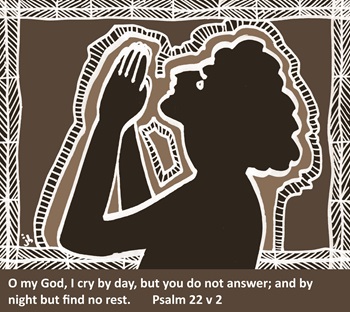
Psalm 022sPsalm 22:2 My God, I cry out by day, but you do not answer, by night, but I find no rest. (NIV)

We’ve all been there at some point in our lives – crying out to God for help, but receiving no response. Usually, the prayer is about our health or the well-being of a loved one. Instead of getting the answer we want, nothing changes, leaving us feeling bewildered, abandoned, even forsaken by God. It makes us question God’s existence, as well as asking what’s the point of having faith if God won’t do what we want?

The Bible doesn’t shy away from those hard questions. Psalm 22 is a prime example of someone who is feeling forlorn and forgotten by God. The writer is feeling vulnerable and lost, finite and frail, so he is looking to God for strength and deliverance, renewal and restoration. It’s a painful psalm to read because it’s written by a tormented soul and even though it ends with some sort of resolution, the sorrows expressed appear to be unanswered and relentless.

Jesus quoted the beginning of this psalm when He was brutally nailed to the Cross. In His final moments of life, He truly identified with the pain, loss, and suffering which all human beings experience. He could have chosen to run away before He was arrested to save His life. He could have called down legions of angels from Heaven to rescue Him from death and destroy His enemies. Instead, He chose to accept a painful end to His life, so that He truly became one of us, as well as the prophesied “Man of Sorrows” described in Isaiah 53.

Perhaps you are going through a hard time and praying for someone you love. Maybe you feel as though your prayers are unanswered and that God doesn’t care about your plight. It’s an awful feeling and heavy burden to bear. I’ve been there, too, but what got me through it was an understanding that Jesus knew exactly what I was facing and had felt the same kind of pain. In other words, He walked beside me to help me endure. I hope and pray He will do the same for you.

Point to ponder: What painful prayers and burdens am I currently experiencing?

Prayer: Lord Jesus, today we appeal to Your humanity and not Your divinity. Today, we pray for You to walk alongside us as we journey through a path of pain and loss. Help us to endure and enable us to overcome. In Your Holy Name, we pray. Amen.

John Stuart is a Scottish Presbyterian pastor now living in Knoxville, Tennessee.

Sabbath Psalms – The World We Live In

Psalm 124sPsalm 124:8 Our help is in the name of the Lord, the Maker of heaven and earth.

Some days I worry about climate change and what kind of impact it will have on my grandchildren. Each year, our little planet is getting warmer, glaciers are retreating, and sea levels are rising. The weather is erratic, and I’ve never seen so many floods and torrential downpours in my thirty years of living in the foothills of the Smoky Mountains in East Tennessee. Some people say it’s just cyclical and eventually the climate will right itself. I don’t know about that; it seems like wishful thinking instead of finding a solution which will help my grandchildren.

Today’s highlighted verse reminds me that God is the Maker of this beautiful planet, so perhaps I should address God, asking for guidance and answers. If human beings are messing up what God created, then why doesn’t God intervene and set things right? As an artist, I take great pride in what I draw or paint and I would hate it if someone vandalized or broke the work of my hands. This makes me wonder if God steps back from Creation to allow human beings to see how destructive we can be, in the hope that we would recognize our mistakes and start to apply our knowledge, wisdom, and skills to repair what we have broken and to cherish what God has made.

The psalmist wrote that our help is in the name of the Lord which tells me that we need to cry to God in order to rely on God to remedy the climate crisis we are in. I think this is why more churches are focusing on environmental health as well as spiritual growth; it’s almost as if the Maker of heaven is encouraging us to be caretakers of the world we live in. I hope so, for the sake of my grandchildren and their grandchildren.

Point to ponder: What do I do in my life to care for the environment?

Prayer: Lord God, You created this unique planetary jewel that spins around the Sun as it moves through space. There’s nowhere else like it in our Solar System, so please help us recognize how fragile this world is by giving us the courage to repair the damage we have selfishly and sinfully caused. In Your Holy Name, we humbly pray. Amen.

John Stuart is a retired Scottish pastor now living in Knoxville, Tennessee.

Sunday Shorts – Her Ministry

Ordy 25BsMark 9:35 Sitting down, Jesus called the Twelve and said, “If anyone wants to be first, he must be the very last, and the servant of all.”

Years ago, on Sunday mornings, my wife Evelyn and I would have a coffee at either McDonalds or a bakery. Evelyn enjoys talking to folks and over the years, she developed friendships with the people who worked there. She talked to and helped single mums who were working all day in the restaurant, trying to get their high school diplomas at night. She blethered (an old Scots word for ‘talked’) with the seniors who were regulars, shared family photographs and funny stories with them. She listened to young students who were working their way through college, giving them encouragement to fulfill their ambitions. Evelyn often went just to have a quiet read and a cup of coffee, but I know that she also enjoyed the community of workers she befriended over all those years.

Evelyn did the same at the West Town Mall. She got up early (before 6am!) and did four laps of the Mall. I tried walking with her, but I couldn’t keep up – she walks too fast – and I’m not an early bird either. She talked to all the people in the Mall like they were her best friends – the walkers, the security guards, and the cleaners. When one senior walker was diagnosed with cancer, she made him some cookies and sent a card. When another walker suffered bereavement, she comforted her with prayers and love. I’m not saying that my wife is a saint – although she must be, she’s married to me – but what I am saying is that she has a ministry of her own which is quiet, unnoticed and just based on befriending, supporting, and serving the least among us. Over many years, she has quietly helped people in the congregations I served without drawing any attention to herself. She still does that today by writing and sending cards to folks she knows with words of encouragement, support, and love.

The mission of each church is to do the same. Many people have been blessed by the personal ministries that church folks accomplish with their families, friends, church visitors, and even strangers on the street. These ministries are the least publicized of all, but do you know what? These small ministries are among the greatest in the eyes of God and the most beautiful in Christ’s Kingdom. The best way to serve God is to serve others with faith, hope, and love, as well as respect, acceptance, and compassion.

So, wherever you are today, take time to be interested in other people, especially those who serve you in stores, restaurants, petrol stations, cash registers, banks and supermarkets. They are all children of God’s grace and just like you and me, they need to be appreciated, recognized, and loved.

Point to ponder: Who will I encounter today? How can I serve God by treating them respectfully?

Prayer:            Lord Jesus wherever we are today and with whoever we meet, may we see God’s image in their faces and God’s grace in their eyes. Instead of looking to be served, may we look for opportunities to serve quietly, faithfully and effectively. In Your Most Holy Name, we humbly pray. Amen.

Sabbath Psalms – Sins of Omission

Psalm 019sPsalm 19:12 Who can discern his errors? Forgive my hidden faults.

I once was given the opportunity to teach two English literature classes in my daughter’s High school class. It all came about when her teacher referred to Britain as ‘England.’ My daughter took offense at this and reminded her teacher that Britain is made up of several nations, which includes Scotland. Thankfully, her teacher accepted what she had to say and, in the ensuing conversation, I somehow got volunteered to teach two classes about Scotland’s contribution to English literature, especially the works of Robert Burns, the world’s greatest poet.

This highlighted verse from the psalmist reminded me of something that Burns once wrote. The psalmist talks about hidden faults, and how each of us are blind to some of the persistent mistakes that we make. In the past, ministers would call these the ‘sins of omission,’ the things that we neglect to do, as well as the mistakes that we unconsciously commit. In one of his poems, Burns put it this way:

‘O the pow’r that God wad gie us, to see ourselves as ithers see us.’

(O the power that God would give us, to see ourselves as others see us)

Sometimes, we are blind to the sins we commit and the mistakes that we habitually make. If only we had the power to see ourselves making those mistakes, which others around us notice, for then we would be empowered to avoid repeatedly making them.

Perhaps today we could all make a conscious effort to watch what we do or say; to be careful about the witness to Christ that we project, to be aware that we are not perfect all of the time. And at the end of the day, as we make our confessions and give thanks to God in prayer, let’s also remember to ask forgiveness for our hidden faults, those sins of omission that we constantly fail to recognize.

Point to ponder: What sins do I constantly repeat? How can I change this?

Prayer: Lord Jesus, sometimes we unknowingly hurt other people and offend You with our frequent mistakes. Sometimes the things we say and do, or the things we neglect to say or do, cause us to disappoint others and sin against You. Help us to recognize our recurring mistakes and give us the ways and means to avoid our sins of omission. In Your Holy Name, we pray. Amen.

John Stuart is a retired Scottish Presbyterian pastor now living in Knoxville, Tennessee.

Sunday Shorts – Our Own Rules

Ordy 22BsMark 7:8 “You have let go of the commands of God and are holding on to human traditions.” (NIV)

One of the biggest things that Jesus had to contend with was the fact that some contemporary religious groups had made up their own rules and regulations about applying their faith rather than following the simple commands of God. Take the Pharisees, for instance. They had taken God’s laws about working on the Sabbath to an absurd degree so that if you had a false tooth and kept it in your mouth during the Sabbath, you were actually carrying something which was vehemently prohibited and considered to be a blasphemous breaking of God’s command. Rules like that enabled the Pharisees to consider themselves spiritually superior as they fanatically followed them; everyone else was imperfect and sinful, unworthy of God’s blessing.

When Jesus appeared, He questioned these absurdities and exposed the hypocrisy of the Pharisees. This is why He said they were more into following and idolizing their own rules rather than humbly applying God’s commands. And the more that Jesus pointed this out, the more religious enemies He encountered. Christ was upsetting their rigid religious hold over the people by setting them free with loving commands and compassionate teaching.

Thank goodness we’re not like those absurd Pharisees, right? Wrong!

When Christians become hateful and harass others who are different, marginalized, or foreigners, they are following their own traditions rather than Jesus. When pastors preach about crushing or killing their political enemies, they are making up their own faith and have departed from Christ’s compassionate teaching. When church members support lying leaders and excuse their false statements, they have let go of the commands of God and are supporting the Father of all lies. And when Christian people embrace false conspiracies and pass on wrong untruthful messages or memes, they are worshiping absurd and dangerous ideas for which they will be judged by Jesus for their careless words and sinful statements. Being a Christian does not excuse us from being held responsible; being followers of Jesus does not pardon our prejudice. When we let go of the commands of God and hold on to human traditions, we are putting our souls in jeopardy from which only confession and repentance will be the remedy.

Point to ponder: Am I guilty of following false ways? If so, am I willing to repent?

Prayer: Lord Jesus, sometimes we think that You approve of everything we believe, say, or do. We want You to do our bidding or agree with our understanding. Reveal to us our sinful ways and help us to regrasp and apply the simple commands of loving God and one another. In Your Holy Name, we humbly pray. Amen.

John Stuart is a retired Scottish Presbyterian pastor now living in Knoxville, Tennessee.

Sabbath Psalms – Love and Hate

Psalm 045sPsalm 45:6 Your throne, O God, will last for ever and ever; a scepter of justice will be the scepter of your kingdom. (NIV)

I like the ancient word that is used in this verse for ‘justice’. In Hebrew, it’s ‘misor,’ which refers to something that is geographically flat like a plain or level like a plateau. It’s the equivalent of us talking about fairness where everyone is given an equal opportunity because we’re all on the same level playing field. There is no advantage given to anyone because of their strength, esteem, or power. Everybody is treated the same, so that justice can prevail. There is no special favor or consideration given to one group over another. Justice occurs truthfully and honestly, which is why some courts have a statue of justice being blind. There is no favoritism or patronage given; justice impartially seeks the truth which is why it is a symbol of God’s everlasting sovereignty.

In a world that is beset with powerful liars and chronic misinformation, the truth can often be buried under a mountain of lies. People are manipulated by brazen leaders who twist the truth into what their followers want to hear, no matter how absurd it sounds. It’s a form of evil that repulses God and damages the world. Blindly accepted absurdities can turn into acceptable atrocities where justice is ignored, and prejudice is fully displayed. The terrifying lynchings in our own recent history testify to the wickedness of ordinary people who were absolutely convinced they were supporting and doing the right thing.

If justice is a symbol of God’s sovereignty, then there will come a time when all of those liars, manipulators, and unconstrained leaders will be made accountable in eternity, as well as those who blindly followed them. The misor of God will level and expose everything, so those who should have known better or who deluded themselves will also be held accountable for ignoring the truth and embracing evil.

Point to ponder: What does justice mean to me? Is it the same as what it means to God? Am I guilty of following liars and spreading lies?

Prayer: Lord Jesus, help us to see the world through Your eyes and to seek God’s justice across this planet. Encourage us to express the truth in the face of lies and to confront corruption with faith, hope, and love. In Your Holy Name, we pray. Amen.

John Stuart is a retired Scottish Presbyterian pastor now living in Knoxville, Tennessee.

Sunday Shorts: Bread of Life

Ordy 18BsJohn 6:35 Then Jesus declared, “I am the bread of life. Whoever comes to me will never go hungry, and whoever believes in me will never be thirsty. (NIV)

Recently, our whole family went out for dinner at a special pizza restaurant. The menu was amazing, and we all looked forward to eating our chosen meals. Our two-year-old granddaughter, Ellie, was there, too, but as she couldn’t read the menu, we just ordered her a plain cheese pizza.

When the server came round with some garlic bread as an appetizer, Ellie enjoyed a piece and declared it to be ‘yummy.’ She ate several more pieces, copying her older cousin Andrew, but when the server arrived with the pizzas, she didn’t want any. All that she desired to eat was more bread. She loved the taste and the texture, so she didn’t want to replace it with something else. While we all ate our chosen meals, Ellie was content to eat what was left of the bread. She knew what she liked and didn’t want to change it for anything.

When I read today’s verse where Jesus declares Himself to be the Bread of Life, I wonder how many of us are satisfied with what He has to offer us spiritually? Are we ready to accept all that Jesus brings to the table of our lives, and is it sufficient for our spirits and souls? Once we taste the bread He offers, are we content to keep feeding from Christ’s life and teaching, or do we set His pieces aside each time we come across something spiritually novel or new?

When Jesus spoke to His people about being the Bread of Life, He lived in an age where Roman emperors placated the unruly mobs in Rome with bread and circuses. The temple at Jerusalem was also a place where the best bread in the nation was religiously displayed and replaced every week, so when Jesus said He was the Bread of Life, He was radically declaring Himself to be better than the emperor and greater than the temple. It was a bold statement and one that would cost His life. Christ sought to inform His followers that as far as spiritual nourishment was concerned, He was more than enough for all of them.

Today, Jesus speaks to us through the Gospels with the same declaration, telling us in this 21st century that He is still all we need to nourish our spirits. He has invited us all to taste and see that the Lord is good; all we must do is consume what Christ has to offer.

Point to ponder: How has Jesus become my Bread of Life?

Prayer: Lord Jesus, You offer to sustain us by becoming our Bread of Life. Encourage us to feed on Your words and ways that will sustain our souls and replenish our spirits. In Your Holy Name, we thankfully receive and pray. Amen.

John Stuart is a retired Scottish Presbyterian pastor now living in Knoxville, Tennessee.

My Latest Book: Sunday by Sunday – Year C Gospels

SxS YCPostMy latest book is the beginning of a three-year project that I’ve been wanting to complete for years. I try to write devotionals on Sunday mornings to help church folks, teachers, and pastors focus on God’s Word for each particular Sunday. Over the years, I’ve compiled enough to cover most Sundays in each lectionary year.

My aim is to write a series of books with meditations for the lectionary Gospels, Psalms, Old Testament narratives, and the New Testament epistles.

This first book of devotionals focuses on the Gospels for Year C which begins at Advent on December 1 of this year. It contains seventy meditations including daily devotions for Holy Week, Christmas, and other Feasts. Each devotion includes a highlighted verse, short meditation, a point to ponder, as well as a short prayer. The devotions can be completed individually, with family, or a small church group.

I am already working on Year A Gospels, as well as some of the lectionary psalms. My hope is to produce twelve books which can be read year after year. The books will be available as eBooks for Kindle users (the Kindle app can be downloaded for free on any device or computer) and as paperbacks. The links to this first book are given below. I hope you may at least enjoy looking at them online.

As always, I am grateful for your encouragement and support. God bless.

John Stuart

Ebook and paperback* links

US: https://www.amazon.com/dp/B0DB3TLLYN

UK: https://www.amazon.co.uk/dp/B0DB3TLLYN

Canada: https://www.amazon.ca/dp/B0DB3TLLYN

Australia: https://www.amazon.com.au/dp/B0DB3TLLYN

*paperback copies are only available via Amazon in the US, Canada, and the UK.

Sunday Shorts: The Quiet Woman

Ordy 13BsMark 5:27-28 She had heard about Jesus, so she came up behind him, hidden by the crowd and touched his cloak, thinking to herself, “If I only touch his clothes, I will be healed.”

Over the many years that I have worked in ministry, I have seen many women sincerely serve God in their own quiet way. Some of them have worked behind the scenes preparing food for different social events; others have written cards or given flowers to folks who were experiencing illness, loneliness, or grief. I have also watched other women professionally minister to their called congregations, serving with love, enthusiasm, intelligence, and compassion, even in the face of gender discrimination which still can be found in some unenlightened churches. Their quiet endurance is something that I constantly admire and I am grateful for the essential ministry of women which keeps Christ’s Church alive throughout the world.

In today’s Gospel story (Mark 5:25-34), a wee quiet woman seeks Christ’s ministry of healing. She has suffered from a blood disease that has plagued her life for years. She has sought medical help and spent most of her resources trying to find a cure. When she hears about Jesus coming to her town, she knows within her heart that this will be her last opportunity of being healed.

Her illness, though, has left her without any helpers. She may even have felt excluded from the rest of the religious community because blood issues among women at that time were deemed to be unclean. Perhaps she doesn’t want to draw attention to herself in case someone recognizes her, so she quietly and timidly reaches out to touch Christ’s cloak as He is passing. She believes that whatever power He has can be instantly transferred to her without causing a scandal.

Jesus, however, feels some of His divine power draining from Him, so He immediately stops and asked who touched Him. His disciples explain that many people in the crowd who were pushing and jostling with each other to get near Him, must have brushed against Him. But Christ knows what has really happened and the wee quiet woman, who has already been healed, is terrified of what could now occur. In her heart, she must have thought that Jesus would have rebuked her for stealing some of God’s power and so she kneels before Him, trembling.

Christ then does something beautiful here. Instead of rebuking her, He commends her for being faithful and He even calls her “Daughter,” which meant that she was not only physically healed but that she was completely restored to God. For years, she had been on the outside of the faithful community; now, she was fully accepted back into God’s love.

There are many women in the church who are faithfully serving Christ. They don’t look for any rewards, public praise, or congregational recognition. They just seek to serve Jesus quietly, efficiently, and effectively, empowered by His presence in their lives, and encouraging others by sharing God’s love which has helped them, healed them, and restored them.

Point to ponder: Who are the quiet women in my congregation? Am I grateful for their faith and service?

Prayer: Lord Jesus, today we give You thanks for the quiet women in our churches whose support, compassion, and ministries sustain local congregations everywhere. Bless them for their devotion, leadership, and service which has kept our faith alive for centuries. In Your Holy Name, we gratefully pray. Amen.


John Stuart is a retired Scottish Presbyterian pastor now living in Knoxville, Tennessee.